Monday, 23 May 2011

Etching + Acid + Japanese Papers

 Printed on Hahnemuhle paper. This paper was too heavy for the image and the colors were too explicit for what I wanted to achieve. The lines were too strong also. I do like the blurring and merging of tone so this will be a useful experiment for future work. I have decided to keep the plate one color and just use aquatint only to create imagery.
 I have set up the Nitric Acid at home. I can use it safely outside and move my work along and a faster pace than one workshop day a week ! I have gloves, mask and goggles for added safety
 This plate is processing outside. The acid strength was topped up and working nicely. I feel more confident to do 'spit bite' and mix up stronger acid. Brian ( the technician ) said, ' Never give acid a drink'. This is such a good thing to remember as acid will blow up and react if you DO add water to it!
 The processed plate after several immersions in the acid.
 Plate inked and polished ready for printing. Decided to use grey shades and alot of white.
 The outcome of the second print. I increased the density of color and tone to get more of a sense of drama into the imagery. The edges are torn and generally this image with its textures and divisions worked relatively well.
Experimented further with a second plate over the top allowed me to incorporate the circles as a flat representation of the sphere. I am especially enjoying printing on Japanese paper. It represents the imagery well and allows for fragility and textures to emerge.

Alice Anderson: Childhood Rituals - Freud Museum

Approaching the house you can already get a sense of what is to come. The red hair ties up the house like a giant web - twisted and taught it gives the house a sense of foreboding and tension. This work is called Housebound. I really like the name as well - it adds to the tension of the work very successfully.
Inside on the ground floor there are several installations of objects : a doll covered completely with red hair and mixed media. Around the room a several small human shapes bound tightly into compact shapes. A Film is running on a loop and the hands are working the thread tightly around the finger it is pulling on a paper butterfly below which appears to flutter to life. Eventually the winding of the thread cuts off the blood flow and the finger turns purple. The thread is unwound.
We all remember this 'ritual' as a child. The fear associated with not being able to get the thread off.


Anderson explores the relationship of fairytales and rituals used as a child. She also plays with the mother daughter connection.
Andersons work appears both magical on one level and threatening/unsettled on the other. The work she produces always stays with me for along time. She plays in this space of ambiguity and the whole experience leaves you wanting more. The attention to detail is what I appreciate. The hair in the installations always seems to thread through the buildings. I looked behind a shelf to see where the hair went, it always appears to go through the wall. As I looked I could see pieces of plaster and paint sprinkled in the corner making it seem real - not pretend.

Embossing - Found Objects

 Pins have been a revelation within my work. They transcribe the thorns I used previously. Using them as the imagery for embossing circles has allowed for stimulating new ideas.


a found paper bag adds texture to the circle and plays with the ambiguity of the imagery


This embedment made of concrete holds the lint of my family clothing  -  making a extension and reflection on the book written by John Styles, 'Threads of Feeling' which spoke about the connection of the mother + child through the fabrics left behind as Identifiers. This lint must hold the DNA of my family.


Things Left Behind - Giving Meaning To My Collecting

found button box

staples left in a board outside Intaglio print supplies

skateboard remnants - London

skulls + bones

 objects collected from a recent family house clearing


Saturday, 16 April 2011

Things Left Behind - Giving Meaning To My Collecting

Collecting is an obsession and also part of my art process. My proposal topic 'Objects and Orphans' is allowing me to look at my collecting habits and use it with more of a discerning eye.
I have noticed that I have to resonate with the object at some sort of emotional level.

Recently I acquired two objects. Both of these have an immense amount of emotion attached to them. One is a chair which is an object from my Mother's house. The other is my Mother in-laws plaits from when she was a young woman.

I am both imagining and emotionally observing  the process of the women who left their babies behind at the Foundling Museum in the 1700's. They left objects known as identifiers ,with their child sometimes as a desperate attempt to maintain a bond and perhaps allow the identity of the child to be known to her should she one day return to reclaim her child.

In holding these objects ( pictured below ) I have and feel a sense of loss, perhaps just as the mothers of these children did, accept my process is in reverse  - I am the 'child'. This is why I collected these particular objects - to connect and maintain a bond.


Progression - Thorns > Pins

Foundling Museum


The Foundling Museum was founded by Royal Charter in 1739. It was 
founded by the determination and tireless petitioning of a man of principle,Thomas Coram. The destitute would have somewhere to deposit their babies and give them a future. 

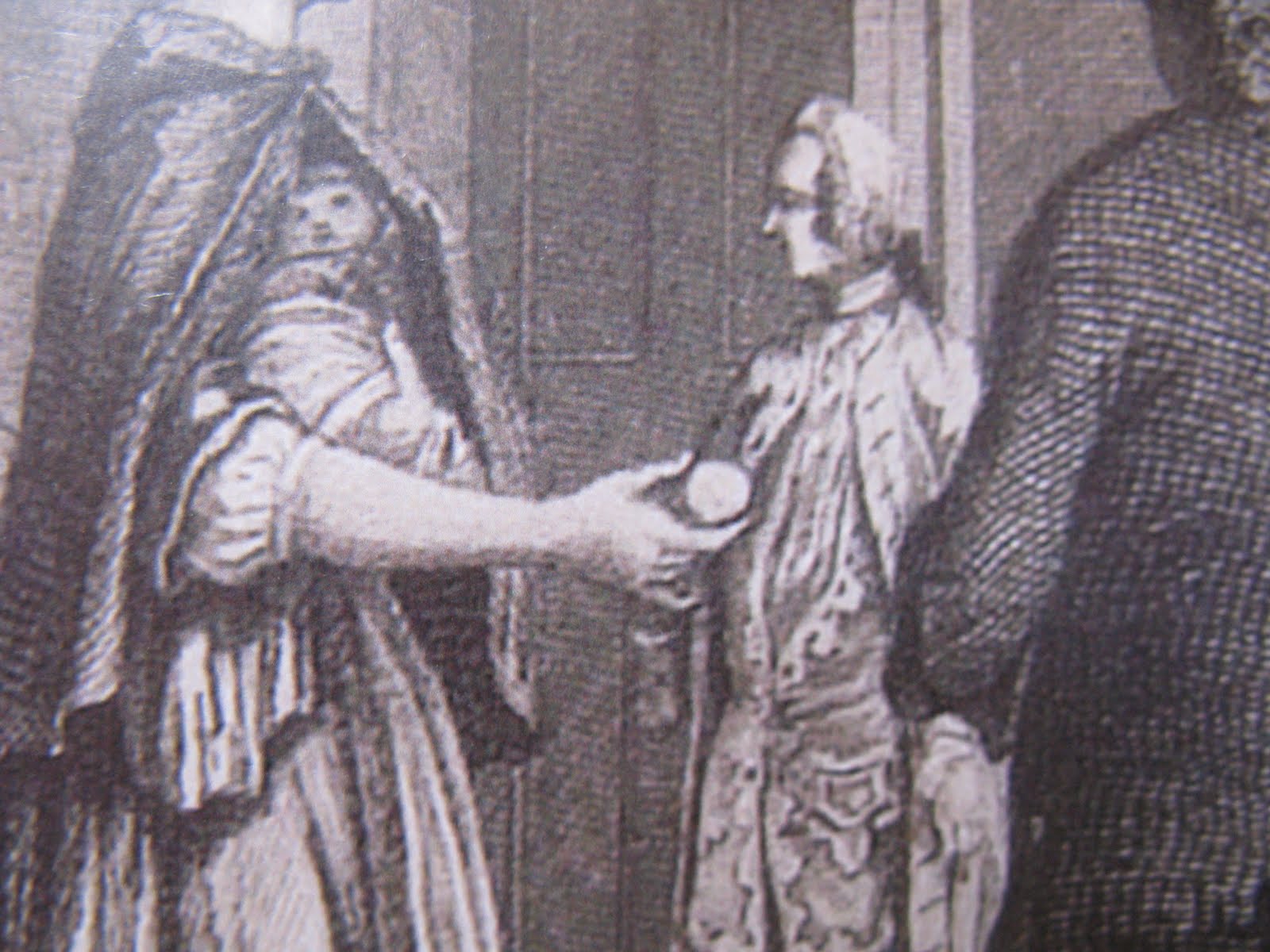
This process was however a lottery, the mother would come to the Hospital and have to take a ball out of a bag. The ball would be red, black or white. Red stood for 'maybe' , Black was for 'no' and white was 'yes'.

I am currently trying to replicate these balls in etching. The perfect sphere. Hard to achieve as I have discovered and you can see below. My next attempt will be using etching techniques from the time of the museum such as Mezzotint and Cross Hatching.


detail of engraving by Hogarth - woman
 taking a ball out of the bag
white ball means she can leave her baby
On my last visit to the Foundling Museum in London, I became a member.http://www.foundlingmuseum.org.uk/ I have been attending talks given by John Styles who has written 'Threads of Feeling' - the Foundling Hospital's textile tokens, 1740 - 1770    http://lecturelist.org/content/view_lecture/9228

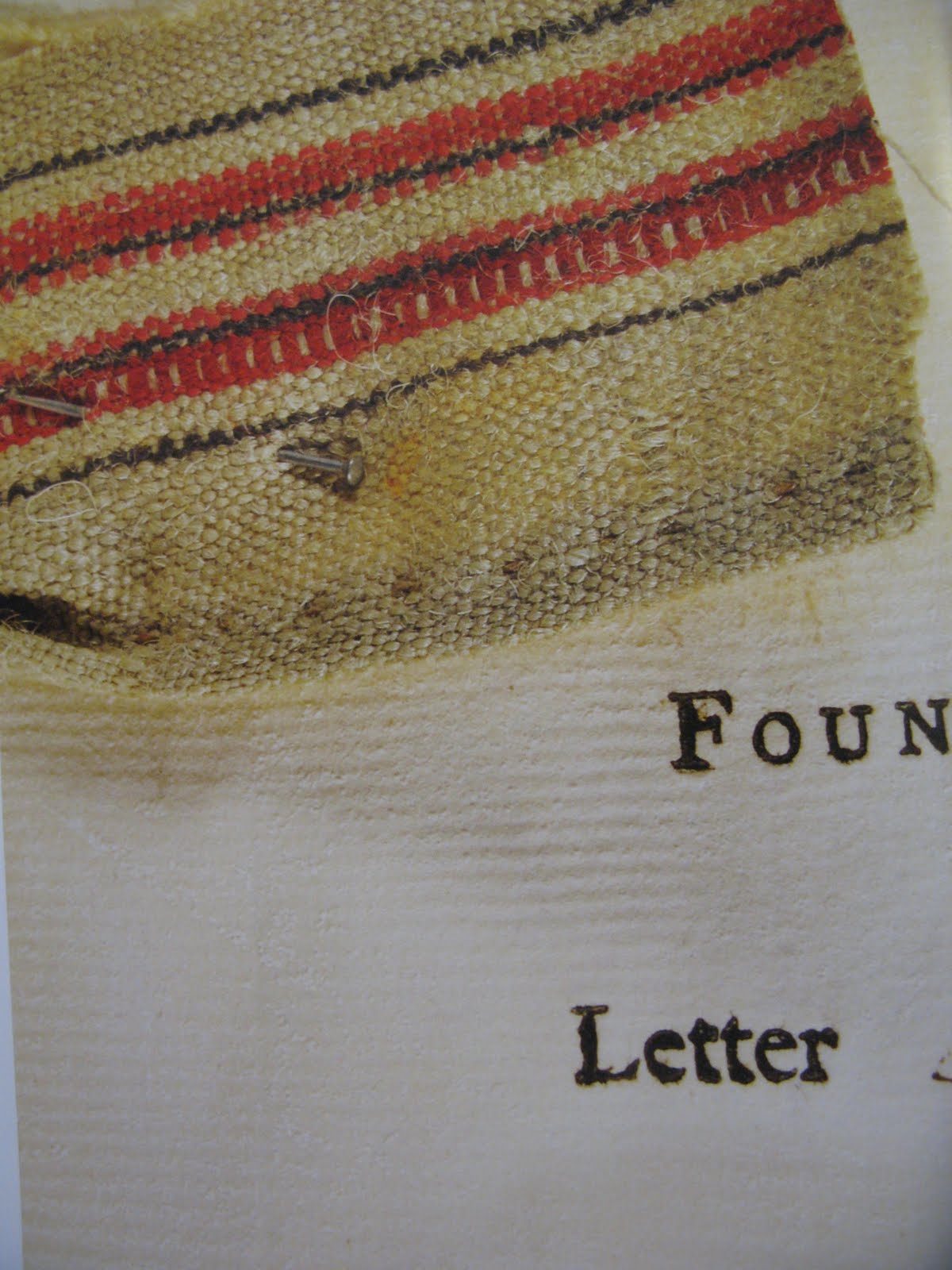
It was during this particular research that I discovered the use of pins. The pieces of fabric left behind by the Mothers or sometimes cut away from the clothing the child was wearing at the time of admittance. These were preserved and pinned into a large ledger book. This got my attention and over time I started to assimilate my personal use of thorns associated with the death of my Mother with the use of pins in the Foundling ledger books. 
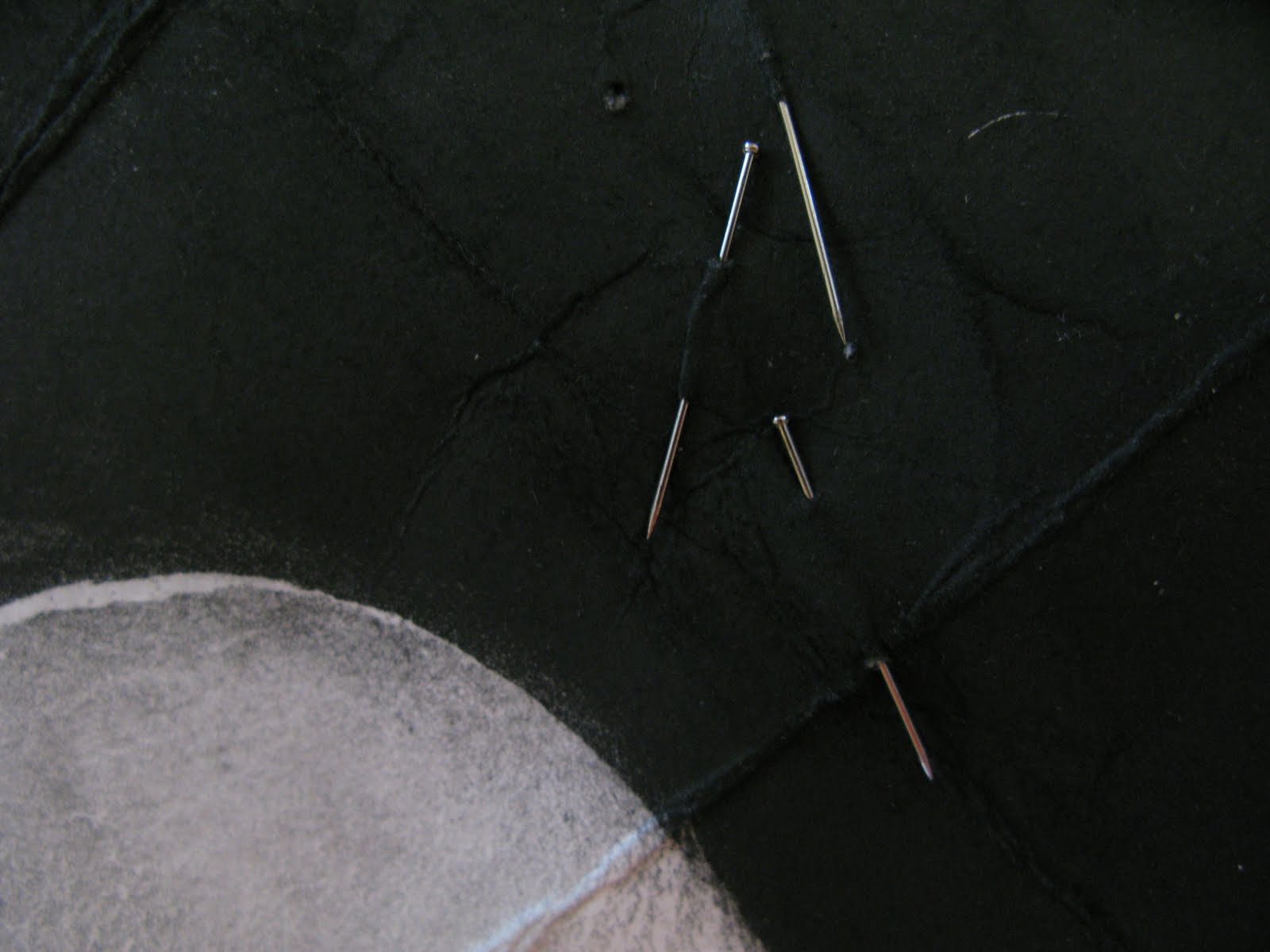
As a consequence I am experimenting with the pins being used within my printmaking process. Piercing the surface of the print and sometimes only leaving impressions.


Pins inserted into fabric identifier
trial print with pins

Sheela Gowda - Therein & Besides

I recently went to the Iniva, Rivington Place
( Institute of International Visual Arts )http://www.iniva.org/about_us to view Indian artist, Sheela Gowda's sculptural works.

Gowda initiates her projects through an interest in the materials she encounters - the everyday materials. She tests out these materials to explore and tap into its potential as a support or vehicle. This enables her to talk in her art language of abstract form, with references to society.

She asks questions around the materials she uses -  'What will happen if I burn it, flatten it,or weave it?'. Gowda works her way through trial and error as a way of 'thinking' through her ideas.

Two separate rooms were used to display these sculptures. I find her work demands you walk around and take in the landscape. For example,  'Collateral' a sculpture which defines  two meanings of the word.
1) Belonging to the same ancestral stock but not a direct line of the descent
2) parallel or corresponding in position, time or significance.
This work is made of the material used to produce incense sticks. Gowda discovered that you could roll out the dough into shapes and forms then burn it and leave the ashen traces behind. This was done on a eight human size, raised beds.

At first I thought it was burnt food, chapatis. Then I got a sense that I was perhaps looking at a landscape of somewhere . . . .  a war torn country. This is when the name made sense and collateral damage comes to mind.
The incense lay flat and looped around, not quite matching up in the layout. I found I could not put it in a box so to speak and in this sense I found the work very powerful. The sense of smell was absent so the material was a mystery until you read information. If it did smell it should have been a scorched smell - not the pungent refreshing smell of incense. I felt this stimulated my line of inquiry into this work. As a viewer, you get the sense of the artist playing with materials, it really comes through as a complete and holistic process.

I felt this work related very strongly to my own process, on the basis of 'things left behind'. The aftermath of an event / situation or in this case the aftermath of the work being made  - the remnants of ash.